Showing posts with label farmer. Show all posts

Wednesday, March 27, 2013

BUTTERFLY FARMING IN ZANZIBAR

At the Zanzibar Butterfly Center, visitors get to experience the first moments of a butterfly's life,
while the Center provides an income for local farmers and incentives them to protect the tropical forest.
While traveling and volunteering, we often meet or hear about creative people doing innovative things to help alleviate poverty. Until a recent visit to the Zanzibar Butterfly Center, however, we had never imagined farming butterflies as an engine to support local economies.

Figo the butterfly farmer
But just ask Figo, one of the more than 30 villagers who raise caterpillars for the Center in the island's tropical forests. The young entrepreneur filled us in on the practice's viability.

"It gives us a reliable source of income," says Figo, who lives near the Center and became a butterfly farmer three years ago. "It also gives us a reason not to cut down the forests, which we used to use for charcoal."

Farmers like Figo can earn a steady income, selling their "crops" either locally to the Butterfly Center, which needs a constant supply, or for export to markets as far away as Europe. 

Depending on the species of butterfly the pupa will produce, farmers can earn anywhere from 25 cents to one dollar per pupa, also called a chrysalis. Since most butterflies live only 2-3 weeks, the work and resulting income is steady, as long as there is demand.

Liz peers into the raising cage, where mature pupae are glued to sticks. There, they will eventually emerge as butterflies, which you can witness during your visit to the Zanzibar Butterfly Center.
Founded six years ago by a Scottish ecologist, a Zanzibari forester and a Tanzanian conservationist, the Center received a United Nations SEED grant last year, recognizing it for sustainable development and environmental innovation. 

"Visitors can see and touch all stages of the life cycle, from egg to caterpillar to pupa to new-born butterfly," said co-founder and Scotsman, Benjamin Hayes. "It's one of the biggest butterfly facilities in Africa, and every visit helps us support the local farmers."

The glistening green chrysalis of the Gold-banded Forester is dotted with gold flakes.

If you get to Zanzibar, make sure you drop by the Center for a visit. Enjoy the surroundings, learn about the insects' life cycles, and best of all, try to stand still while watching a newborn butterfly take its first flight from the palm of your hand. 

Best of all, remember you're visit and dollars help support the livelihood of some of Africa's only butterfly farmers. 

ZBC founder Benjamin Hayes (left) and a volunteer show off a collection of pupae. 
An African Monarch, also called a Plain Tiger, rests on a leaf at the Zanzibar Butterfly Center.

Sunday, November 4, 2012

PLAINS AND MOUNTAINS ON THE TIBETAN PLATEAU


On the downhill run from Lhasa into Nepal, roads are lined with arid plains dotted with goats, cows, miles of barley, and the ruins of thousand-year old structures that are slowly melting back into the earth (see two "mounds" in the middle right). The golden fields stretch for miles until they collide with rolling hills that morph slowly into mid-size mountain ranges--in a land where 18,000-foot peaks are "mid-size"--and finally, into the Himalayas. 

It only took us eight days, but we finally got a decent photo that included Mt. Everest (at least, our guide assured us the peak in the background is the highest one in the world). 

On toward Nepal and a trek to Mt. Everest Base Camp. We hope.

Tuesday, July 31, 2012

UPRIVER AND LEARNING A LITTLE LAO

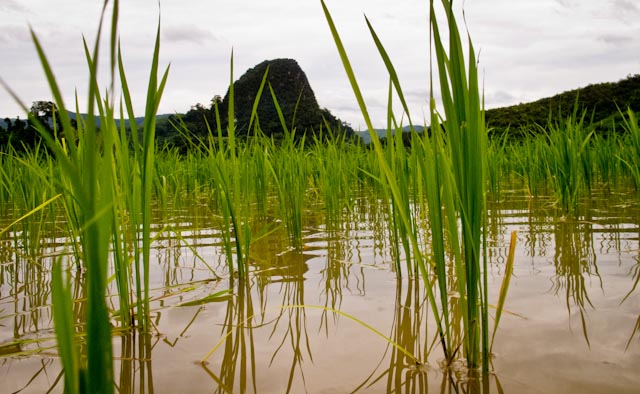
Growing rice, up close and personal.
Heading up Laos' Nam Ou river, a seven-hour boat journey from Luang Prabang is the sleepy town of Nong Khiew. Being that we have grown wise in our travels, we knew that while scenic, a seven hour trip seated on a wooden plank with our knees up near our ears--the only way to travel by water to get to the village--didn't sound all that great. So, we opted for the local bus...only three hours and less than half the price (see how smart/cheap we've become!).

The entire town is located along the river, with a huge bridge spanning the rushing red water. Limestone cliffs tower overhead with lush jungle in between, skirted by an eerie fog that hangs around in the early mornings. We managed to find a hotel room whose main features included a constant leak in the ceiling and a resulting massive puddle in the middle of the floor...but the place also had a balcony and a hammock with amazing views! The balcony was crucial, since it rained the entire time (it is monsoon season, after all) and it was nice to get away from the puddle now and then.

Just an hour farther up the Nam Ou is the even smaller village of Muang Ngoi Nuea (don't ask us how to pronounce this either...Liz got it wrong every time, resulting in us almost getting on a bus bound for the Chinese border). The settlement is accessible only by boat and has electricity for just a few hours each day. Supposedly, the power comes on at 6 and goes off at 10, but in reality, it came on around 7:30 and went off at 9.

While the tiny town itself had little to see, the highlight of Muang Ngoi is a trek along the trails where no motorized vehicles have gone. One morning, Liz headed out for the village of Ban Na, a 45-minute walk into the mountains. On the way she met a very outgoing, 20-year-old rice farmer named "Eh" (not sure how to write that in English, but this must be close).

Eh looking for snakes on the trail through the rice paddies.
Eager to practice his limited English, Eh offered to accompany Liz on her way and showed her a shortcut through the rice paddies, which were incredibly slippery from all the rain. Eh quickly learned how to say “slip and fall," since Liz did exactly that every few minutes along the trails.

Between her graceful falls, Liz learned a phrase in Lao that her new friend Eh thought was very important: “Wait for me!”

He explained that, “If you are in the toilet at the bus station and you hear the motor of your bus start up, you can shout this to the driver and he must wait for you.”

Hard to argue with that logic.

While that exact circumstance hasn't happened (yet), it's been priceless to see the faces of the local transport drivers when we step smilingly into a bus, boat, tuk-tuk, or taxi and say in near-perfect Lao, "Wait for me!"

Now if we could just learn to say, "Where's the bathroom?"

Six muddy water buffalo squeezed into a small pool.
Boats on the Nam Ou river, and the bridge of Nong Khiew.
An albino water buffalo. We thought they were rare, but saw many in Laos.