Showing posts with label strange. Show all posts

Wednesday, October 17, 2012

STARES, SMILES, AND BYE BYE BURMA

Stares and smiles greet us at a train station in rural Myanmar. 
As a foreigner traveling in Myanmar, you tend to get a lot of stares, particularly in the more rural areas where few tourists visit. It's an odd feeling at first, when a farmer stops his oxen team to wave or a group of kids halts a pick-up soccer game to point at the strangers strolling past. 

Perhaps it's somewhat akin to what it feels like to be a celebrity, but without the money, agents, or paparazzi.  

Eventually, you get used to it, even looking forward to it after a long day sitting on a bus or train. You soon learn that, with a quick wave and a smile, the uncomfortable stares morph into some of the warmest faces and most sincere greetings on the planet.

It's what we'll miss the most about Burma--the people.
More smiles from the train.
We'll remember Myanmar's citizens much more fondly than we will the country's two largest cities, Mandalay and Yangon (Rangoon), both of which, thanks to traffic, smog, dust, trash, noise, and a lack of much to see or do, we weren't huge fans of. 

We also won't get nostalgic for the buses, the over-priced hotels, the government limits on where visitors can go, or especially the country's cuisine, which is infamously underwhelming, despite being surrounded by the culinary-capitals of Thailand, China, and India. For example, Myanmar's most widely-used food product is a putrid-smelling paste called "ngapi" made from fermented fish or shrimp.

Despite the aforementioned drawbacks, Myanmar is not a bad place to visit--especially because of the people met along the way, like the U Paw Sans in Inle Lake and the giggling children everywhere we went--they made the trip complete. 

So here's hoping, with the continuing increase in tourism and growing foreign investment (rumors abound of the country's first McDonalds and Starbucks opening soon...), the lives of those in Myanmar improve dramatically while their openness and friendliness remain as they are today.

As a farewell to Myanmar, below are a few parting shots as we head to Nepal...

MORE ON THE TRAIN TRIP TO NAY PYI TAW
The 12-hour ride from Bagan to the capital, while not exactly comfortable, was as scenic a ride as we had in Myanmar. 
While one railway car does not a train make, it was still a fun ride, thanks to the kids...and the stowaway below.
A lady delivers grass to cows across the tracks.
A cute, stowaway joined us on the trip.


NAY PYI TAW--MYANMAR'S STRANGE CAPITAL
Myanmar's government relocated the country's capital seven years ago from Yangon (Rangoon) to a rural rice-paddy five hours north. After spending some $4 billion, a new city was born. 
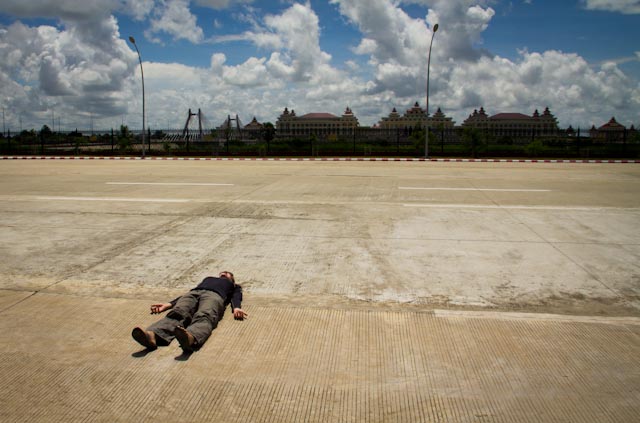
Liz lies down on the deserted 20-lane highway in front of Myanmar's multi-million dollar capitol.
Despite the money, the massive highways and some gargantuan government buildings, the place remains pretty much deserted. A person could sleep safely in the middle of the 20-lane road in front of the capitol building. 

Embassies, NGO's and international workers have refused to leave Yangon, while the government has attempted unsuccessfully to force its own workers to relocate full time. They even built housing compounds for staff, complete with color-coded roofs, corresponding with the department in which you work. We can't imagine that would go over well back home--it would be hard to live next door to your co-workers and/or boss. But then, having a white elephant as a neighbor might help.

The government imported a sacred white elephant to live in the city. Liz loved the blond hairdo. 

It has been an impressive 28 days (the maximum stay allowed for foreigners) but we are excited to move on towards our next destination.  That said, we will certainly miss the Burmese hospitality, which Kip took full advantage of our last day in the country. 
A hotel worker insisted on giving Kip some shade.

Tuesday, September 18, 2012

WORLD'S LARGEST, STRANGEST RECLINING BUDDHA

Burma Buddha 1 of 7 Liz Kip
Looking like a flea on the great Buddha's shoulder, Kip (see blue arrow) peers from a trap door we found.
Why more tourists don't come check out what must be the world's largest--and strangest--reclining Buddha, we'll never know. At nearly 600-ft long and ten stories high, Zina-thu-kha Yan Aung Chan-tha is an architectural marvel by itself. Yet, it's what's inside and surrounding the super-sized statue that should shift it to the top of anyone's must see list for Myanmar.

More akin to a 50-acre Buddhist Disneyland than a solemn place of worship, "Buddha's Playground" can be difficult to describe. Hopefully, the following photos will help.

Lining the entrance to the Park, some 200 stone monks, begging bowls in hand, march solemnly toward the big Buddha. 

The line of saffron-robed men stretches for more than a kilometer, crossing over the road by elevated bridge, heading through a wooded area and finally disappearing over a small hill.


Once beyond the monks the main attraction comes into view, dwarfing everything around it, including homes, store fronts, the surrounding hills and more than 100 temples, pagodas and other shrines built nearby.
Above, that's Kip on the scooter heading toward the Buddha. A basketball court could almost fit on one of the statue's unpainted feet. A pedicure must cost a small fortune.

The 60-ft high seated monk above with bright pink lips is more a diversion than a focal point, though the scaffolding encircling his bald head gives him the appearance of the horror film character Pinhead, only somewhat less menacing.

In addition to strange outdoor statues, the Park even features its own water slide and swimming area at the base of the Reclining Buddha (left). Boys and girls, all fully dressed, raced up and down the five slides during our visit. 

Once inside the cavernous statue, things get truly interesting. More an unfinished construction project than a place of reverence, there's little in the entire statue that's 100 percent finished. The smell of wet concrete, sawdust and paint follow you every step. 

Below left, Liz poses inside one of the Buddha's concrete toes, which, like many other parts of the statue, awaits finishing touches. 

Below right, a boy puts a primer coat of paint on a statue that will fill one of the 182 rooms inside the Buddha. 


In addition to the traditional depictions of the Lord Buddha's enlightenment, you'll see so much more. 

We found life-size images of ancient sea creatures flying through the air, of bull elephants stomping bleeding men, of harems of topless women servicing a prince, and of the devil himself (at left) either pouring glowing coals on suffering victims or helping warm up a clothing-optional jacuzzi.

In addition to the oddities, you will find beauty, as well. 

Below, thousands of miniature Buddha statues covered in dust wait for their turn to decorate a nearby wall or ceiling.


If you can find a window or hidden passageway, get yourself outside the Buddha, where the views are spectacular. 


Above, the vista from the Buddha's shoulder, looking down at the water slide and across to a construction area, then Pinhead to the right, backed by a small lake and beyond that miles of greenery.
Though the Buddha Park remains a work in progress, it's one of the most fascinating man-made attractions we've seen in Asia. 

So if you find yourself in Myanmar with a bit of time and are looking for an off-the beaten track adventure, go check it out. 

Our bet is you'll be glad you did. 

(The Buddha Park is located 20 km south of Mawlmine, Myanmar)