Showing posts with label Burma. Show all posts

Friday, October 18, 2013

PHOTO FRIDAY: "FACES AND PLACES" EXHIBIT IN WASHINGTON

Bridge Crossing in Burma
Since it's Friday and last night was the opening reception of our first-ever photo show, Faces and Places, above is the first print that sold--a shot of two novice monks crossing a handmade bridge near Lake Inle in Burma. 

Thanks to everyone who made it out and helped us open the show, which will be running through Dec 1 at the upstairs gallery in Shaw's Tavern in Washington, DC. 

Sunday, May 19, 2013

KIP'S FIRST MEN'S JOURNAL STORY: STAND UP PADDLING BURMA (SUP MYANMAR)

Some of you might remember the stand up paddling lessons we took in Myanmar, aka Burma, last year. Despite expert teachers, who included the instructor U Paw San's nine-yr-old daughter, we failed quite miserably most of the time. 

On the positive side though, we did get something good out of it--Kip's first piece for Men's Journal, which ran last week. Visit their website, or see intro text below:
---------------------------

MEN'S JOURNAL: The Original SUP

Getty Images

The most technically proficient standup paddleboarders in the world may well be a group of fishermen in Myanmar who have never heard of the increasingly popular sport

These boatmen, who teach their technique in Inle Lake's reed-choked waters, stand on one leg at the back tip of their canoes while using the calf of their free leg to guide a paddle tucked under their arm for leverage. Locals accomplish this while minding their nets and wearing traditional skirts – all the more reason to embrace local knowledge on the way to better SUP form.

Lessons are taught in hand-hewn dugout canoes, which – due to their round-bottom design – are much less forgiving than the wide, buoyant paddleboards used for traditional standup. Standing still at the back of an empty boat is hard. Standing still at the back of an empty boat on one leg while paddling with the other is harder...READ FULL TEXT HERE.

Kip Patrick

Wednesday, October 17, 2012

STARES, SMILES, AND BYE BYE BURMA

Stares and smiles greet us at a train station in rural Myanmar. 
As a foreigner traveling in Myanmar, you tend to get a lot of stares, particularly in the more rural areas where few tourists visit. It's an odd feeling at first, when a farmer stops his oxen team to wave or a group of kids halts a pick-up soccer game to point at the strangers strolling past. 

Perhaps it's somewhat akin to what it feels like to be a celebrity, but without the money, agents, or paparazzi.  

Eventually, you get used to it, even looking forward to it after a long day sitting on a bus or train. You soon learn that, with a quick wave and a smile, the uncomfortable stares morph into some of the warmest faces and most sincere greetings on the planet.

It's what we'll miss the most about Burma--the people.
More smiles from the train.
We'll remember Myanmar's citizens much more fondly than we will the country's two largest cities, Mandalay and Yangon (Rangoon), both of which, thanks to traffic, smog, dust, trash, noise, and a lack of much to see or do, we weren't huge fans of. 

We also won't get nostalgic for the buses, the over-priced hotels, the government limits on where visitors can go, or especially the country's cuisine, which is infamously underwhelming, despite being surrounded by the culinary-capitals of Thailand, China, and India. For example, Myanmar's most widely-used food product is a putrid-smelling paste called "ngapi" made from fermented fish or shrimp.

Despite the aforementioned drawbacks, Myanmar is not a bad place to visit--especially because of the people met along the way, like the U Paw Sans in Inle Lake and the giggling children everywhere we went--they made the trip complete. 

So here's hoping, with the continuing increase in tourism and growing foreign investment (rumors abound of the country's first McDonalds and Starbucks opening soon...), the lives of those in Myanmar improve dramatically while their openness and friendliness remain as they are today.

As a farewell to Myanmar, below are a few parting shots as we head to Nepal...

MORE ON THE TRAIN TRIP TO NAY PYI TAW
The 12-hour ride from Bagan to the capital, while not exactly comfortable, was as scenic a ride as we had in Myanmar. 
While one railway car does not a train make, it was still a fun ride, thanks to the kids...and the stowaway below.
A lady delivers grass to cows across the tracks.
A cute, stowaway joined us on the trip.


NAY PYI TAW--MYANMAR'S STRANGE CAPITAL
Myanmar's government relocated the country's capital seven years ago from Yangon (Rangoon) to a rural rice-paddy five hours north. After spending some $4 billion, a new city was born. 
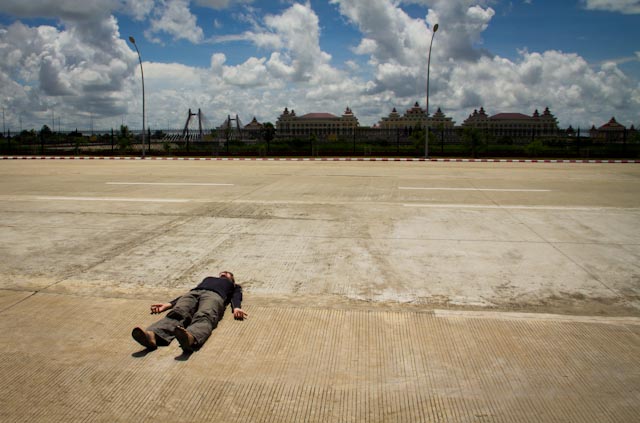
Liz lies down on the deserted 20-lane highway in front of Myanmar's multi-million dollar capitol.
Despite the money, the massive highways and some gargantuan government buildings, the place remains pretty much deserted. A person could sleep safely in the middle of the 20-lane road in front of the capitol building. 

Embassies, NGO's and international workers have refused to leave Yangon, while the government has attempted unsuccessfully to force its own workers to relocate full time. They even built housing compounds for staff, complete with color-coded roofs, corresponding with the department in which you work. We can't imagine that would go over well back home--it would be hard to live next door to your co-workers and/or boss. But then, having a white elephant as a neighbor might help.

The government imported a sacred white elephant to live in the city. Liz loved the blond hairdo. 

It has been an impressive 28 days (the maximum stay allowed for foreigners) but we are excited to move on towards our next destination.  That said, we will certainly miss the Burmese hospitality, which Kip took full advantage of our last day in the country. 
A hotel worker insisted on giving Kip some shade.

Tuesday, October 16, 2012

MYANMAR IS WINE COUNTRY?

Red Mountain Vineyard
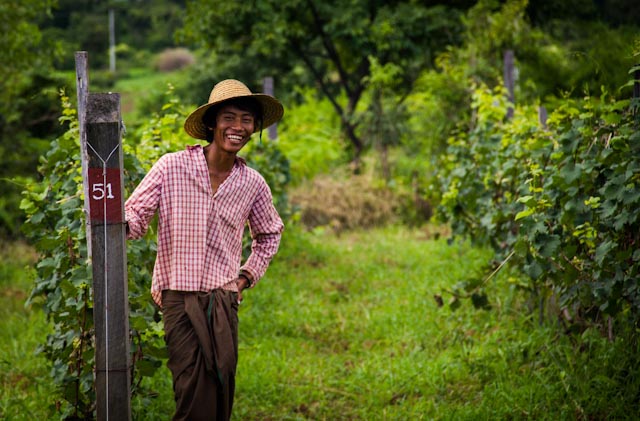
A vineyard worker near Inle Lake wields a large knife used for trimming vines...and for welcoming thirsty tourists. 
When you think of Sauvignon Blanc, Burma is probably not the first place that comes to mind. But if a few forward-thinking vintners have their way, someday it could be. 

The hilly area surrounding Inle Lake in northern Myanmar is said to be prime grape-growing territory, or so we heard often during our recent visit. While we rarely drink the stuff ourselves (ahem), we thought it worth investigating these claims for the benefit of our countless handful of readers. 

There are actually two vineyards in the vicinity of Inle Lake. Only one was close enough for an out of shape tourist (Liz) to reach by bicycle, so we opted to head to Red Mountain Estate Vineyards and Winery.  


Following a paved, winding road bordered by rice paddies, we reached the vineyard after a 20 minute ride from Nyaung Shwe, where we were staying. After passing the entrance gate, the road makes a steep climb to the top of a hill. 


The view from the top is impressive, with rolling, vine-covered hills, all the way to the lake. It certainly looked like a vineyard. 

Thirsty from the long ride from town, we went immediately to the tasting room, lest we risk dehydration from the heat and exertion. We sat down and perused the menu.

Because wine rarely passes our lips (ahem) we weren't sure which wine to order. So we decided to try them all. It was a good decision.

After the tasting, Naw Naw, our somellier offered to give us a tour of the grounds. We learned that globalization is alive and well in Myanmar. The wine maker comes from France, the vines came from France, Spain, and Israel, the oak barrels from Hungary, the Swiss-engineered equipment hails from Italy, the bottles from France and China, and the labels are designed right here in Myanmar. 

We're not sure how we remember the above statistics, as things got pretty unruly during a part of the tour. Lucky for us, Naw Naw is a very patient woman.


After purchasing a bottle for the bike ride home dinner later that evening, we headed  back down the hill.

The vineyard workers had just finished and were heading home, and the light was perfect, so we couldn't help but snap a few hundred photos. Here are some of our favorites, including another of our friend the knife-wielder. 


Saturday, October 13, 2012

STAND UP PADDLING VIDEO

Our many readers (both of them...thanks Mom and Dad) have been asking what "Stand Up Paddling Burma-Style" actually looks like in action.  Miraculously, we happened to come across a video we took that shows the man himself (U Paw San, not Kip) in perfect form, effortlessly moving through the water.

He makes it look so easy. We can assure you, it is not. 

Background soundtrack is provided by the chanting monk from the monastery adjacent to the river.

Enjoy.


Wednesday, October 10, 2012

THE TEMPLES OF BAGAN


The ancient city of Bagan, dotted with hundreds of stunning temples, is best explained through photos (particularly when internet connections don't allow for much else). 

Above and below are a few. 

Leaving Myanmar soon...NEPAL AND EVEREST HERE WE COME. 


Thursday, October 4, 2012

STAND UP PADDLING IN BURMA

What stand up paddling in Burma is supposed to look like.
Move over stand up paddle boarding--there’s a new sport in town. Pioneered decades ago by Burmese fisherman in the shallow, weed-filled waters of Inle Lake, this acrobatic style of stand-up paddling may soon knock “SUP” from its perch as the latest, greatest thing in water sports.

If you’re not familiar with the soon-to-be-outdated American version of SUP, there are plenty of photos of bikini-clad celebrities doing it on the internet. Basically, participants would stand atop an over-sized surfboard facing forward, then, slightly bent at the waist, they paddle the traditional way on either side of the board, balancing and steering as they go.

So simple, even a celebrity could do it.

The Burmese version of SUP, however, requires far more skill and agility. Plus, men usually wear skirts, so there’s that. 

Our nine-yr-old English student gives us a lesson.
Here, the locals stand on one leg balanced at the tip of their dugout canoes. From there, they begin to paddle with one arm and one leg, while at the same time doing a whole host of other things such as fishing, farming, collecting sea weed...you name it, they can do it, while balanced precariously on a spot most people wouldn't even be able to stand in. 

Using the calf and heel as both fulcrum and lever, they power the paddle with one leg while using an arm to help fine tune the motion for steering, speed and navigation. It's hard to explain on paper but it's poetry in motion to watch...when done right.

Naturally, we had to give it a shot ourselves. And who better to teach us than our adopted family, the U Paw San's?

While it took us quite a while to explain to them the concept of teaching someone to stand up paddle (even nine-year-olds can do it...it's not really something to be taught, they said), U Paw San's wife and daughter agreed to give us both a lesson. 

The results were initially less than stellar. Simply standing up in the canoe proved difficult. Kip fell in immediately, luckily only in a knee-deep rice paddy. But after a while, both he and Liz got the hang of it. Mostly.

Kip getting a lesson from U Paw San's patient wife.
Out of the rice paddy and into deeper waters. Still not at the tip of the boat though.
Graceful Liz picked it up pretty quickly.
Clumsy Kip needed another day's lesson.
On day 2, properly dressed in a traditional longyi, Kip finally gets the hang of things.  Having a laughing, somewhat terrified nine-yr-old tutor in the boat definitely helped. 
When the lessons were over and we'd dried our clothes from the splashing, we suggested that giving tourists stand up paddling lessons could be a booming new business opportunity. U Paw San said he was willing to give it a shot. 

Together, we put together some text in English to promote the stand up paddling lessons. The language will be used on a flyer and a large sign to let visitors know lessons are available for what may soon become the world's next big water sport. 

The ground work has been laid. Celebrities, you best get prepping. 

Wednesday, October 3, 2012

BURMA BUYER'S GUIDE


If you're entering a pagoda in Myanmar, you buy chains of flowers from local sales ladies to place on altars inside. 


If you're at a market, you might pick up some candles from this guy.  


Or perhaps some of these carved statues, necklaces, or bracelets from this lady.


If you're visiting a market that sells ugly hats, you might pick up a tribal beauty like this one, made of a boar skull nicely decked out with hundreds of buffalo teeth. Price was $250--way out of our price range luckily--otherwise, a couple of these would no doubt be decorating our walls back home some day.


If you're at a fish market, you can order a plate of freshly fried nga hpein (lake carp)..as long as a cat doesn't get at them first. 


Sometimes in Burma, you don't need to buy anything, and you can enjoy a priceless moment making a new friend or two for free while watching a sunset. 

This guy liked Liz almost as much as the "swing me" kid (see photo at bottom of link) near Lake Inle. 

Friday, September 28, 2012

PHOTO FRIDAY: WATERFALL-LOVING WATER BUFFALO


Readers of this blog will know that we have a corny appreciation for many things, but our two favorites are waterfalls and water buffaloes. Walking along a stream in eastern Myanmar, we heard the steady rush of falling water combined with the happy splashing of something large. The photo above is what we saw. While it may not be the most picturesque scene in Myanmar, it definitely brightened our day (not to worry about the blue rope in his nose--it's the Asian version of a bridle or nose ring).

The only thing that would've made the moment any better is if we could have somehow worked a sunset into it.

Wednesday, September 26, 2012

READING ENGLISH BY CANDLELIGHT


The best part of a visit to Myanmar is meeting the people who live here. Despite plenty of reasons to be less than happy, (rampant poverty and a life under a totalitarian government, to name two), the folks we've met have been some of the happiest, friendliest anywhere. 

On a bicycle ride through one of the local villages near Inle Lake, we met a man named U Paw San. He was walking with his nine-year old daughter along the shore. We said hello, he said hello. We were lost, as usual, so we asked U Paw where the dirt track we were on was headed. Luckily, he spoke some English. He gave us directions and then answered a few our inane questions about where to see birds, what time the sun sets, and if we were allowed to even be in his village.

The next thing we knew, he invited us to his house to meet the rest of his family and to have tea. It may sound somewhat abrupt, strangers getting asked into someone's home, but this quick hospitality happens often here. You start up a conversation with a local, and in two minutes, you're holding their baby or giving them high fives or having tea at their house.  

The most rewarding part for us came when his shy daughter finally started talking to us. Over hot tea, U Paw told us she was one of the top students in her English class at school, and she really wanted to practice. But she wasn't used to meeting strangers. 

www.1of7.org  1 of 7

By the second cup, and after much encouragement from her dad and mom, she brought her little backpack to a small table on the floor, pulled out her English workbook and started reading off a list of vegetables in English to Liz. There was no electricity in the house, which was built on wooden posts for flood protection, so we drank, read, and studied by candlelight. 

After about two hours of reading and talking, she decided to show us everything in her backpack. In addition to papers and well-used school books, the most interesting thing she showed us was her pencil sharpener--a small straight razor, which she was quite adept at using, much to her dad's delight. It's hard to imagine seeing 20 nine-year olds in class all whittling pencils with razor blades at the same time. 

Typical of Burmese hospitality, U Paw and family invited us to come back the next day. We couldn't say no, and we spent most of the day with them (more about that later), culminating in another candlelight English session over tea and rice cakes. As a bonus, the daughter taught us to count to 100 in Burmese. 


After spending so much time with the family and meeting so many neighbors in the village, we took some photos of everyone and printed them out as a thank you for adopting us temporarily. 
U Paw San's niece, face smeared with thanaka, came downstairs to read with us for a while. U Paw's parents and sister's family live upstairs in their two-room house. 

Mom holding MoMo, their youngest, surrounded by five young neighborhood boys.
Mom and son MoMo. They have four children total--three boys and a girl.
Liz playing "swing me" with a new friend. 

Monday, September 24, 2012

FUNNY MONDAY: ONE BORED MONK


Everyone gets bored sometimes--even, it would seem, novice monks who've been studying and meditating for hours. We saw the young Buddhist above sitting on the steps of his monastery one afternoon during a float trip along the shores of Inle Lake. 

At first we thought he was in deep thought, contemplating the day's lessons. But when our boat got closer, we realized he looked just like hundreds of other teens his age in need of some excitement. After a few waves and shouts of "Mingalaba!" from our boat, we finally got him to smile. But as soon as we were gone, he re-assumed his previous position. 

Being a teenager is hard work no matter where you are.

Saturday, September 22, 2012

KIDS, CAVES AND CRUISING IN KAYIN STATE

These kids were very shy...as in, climbed up onto our motorbike to have pictures taken with us.
Happy kids, they're ridiculously contagious. No matter where you are, a group of smiling, giggling kids will light up your day, especially when they're giving you hugs, kisses, and hi-fives for no good reason whatsoever. 
Once Liz found the puppies, the boat ride was forgotten. The
bus was almost forgotten too until Kip pulled her away.
It all began with a broken down ferry. We really wanted to take a boat trip up the Thanlwin River from Moulmein, where Rudyard Kipling visited and composed some prose. Unfortunately, the ferry that the guide book said made the trip is out of service. Permanently.

But who needs boats when you have a bus station (read: empty lot) complete with puppies and local women selling all kinds of snacks from baskets on their heads. Plus, monks take the bus, so it must be good.
A Burmese woman sells fruit from the basket balanced          
           on her head.


After a short two hour ride through parts of the beautiful countryside of the Mon and Kayin States, we arrived at Hpa An (pronounced: Puh Ahn). We had almost forgotten we were in a country where the government demands extreme, totalitarian control of its citizens, until we came upon an English translation of a billboard we had seen in several places (see below).
A multi-lingual billboard that explains the goals
of the Myanmar government. 


Seeing as how we had no intentions of disintegrating the union, or national solidarity (at least for the moment...we had just arrived, after all) we decided to see some of the sights around the area, of which there are more than two

And, since we missed out on our scenic ferry ride, we were lucky enough to find a willing boat driver to take us out for a three hour tour on the river, past river villages and many pagodas best viewed from the water. 
View from the river of one of the many golden stupa topped islands.
With our river cruise behind us (gladly, as our boat turned into a sieve halfway through) we opted to explore the countryside on a motorbike, one of our favorite things.  We are glad we took advantage, since the government recently restricted motorcycle use by foreigners in most areas of the country due to "safety concerns."

We may have gotten lost a few times on the back roads, but there were always plenty of villagers who, though they spoke no English, pointed us in the right direction. Kip even tried to ask this new baby goat for directions, but couldn't get a straight aah-aah-aah-answer.

At last we arrived at the Kaw-goon Cave, one of many limestone caves in the area that are religious sites. This cave, with statues and carvings dating back to the 13th century  has its own monastery, koi pond, and numerous Buddha statues.
Kip gets a closer look at the intricate wall carvings of Kaw-goon Cave.
As we set off for another one of the area's caves, we spotted the tip of the gravity defying Kyauk Kalap pagoda above the trees. As impressive as it was from afar, it was even more so up close, enhanced by the groups of brightly colored monks that were laughing in a group at the beginning of the bridge. 
Monks cross the bridge over the lake to their island monastery.
And, to make this temple even more amazing, was our welcoming committee of local kids in traditional Kayin dress. We got lots of hi-fives, and were even asked to pose for a few photos. We chatted for a while, and Liz impressed them with her ever growing knowledge of Burmese (about 5 phrases), which they found hilarious. 
Kip poses with this awesome group of fun kids.
They sent us off with hugs, kisses (for Liz), and more hi-fives. What can we say, we love this place.