Showing posts with label Laos. Show all posts

Saturday, August 18, 2012

SE ASIA'S MOST RELAXED CAPITAL

Kip and friend Chris check out Vientiane's Patuxai Arch.
Compared with the sprawling Malaysian capital of Kuala Lumpur, Laos’ capital city Vientiane seems like a small town. While KL has soaring skyscrapers like the Petronas Towers and KL Tower, Vientiane’s skyline features few buildings more than five stories tall. Instead of glitzy shopping malls the former French-ruled city has tiny mom & pop shops selling everything from custom-tailored suits to old stamps from decades past. But what Vientiane does not have in height or glitz, it makes up for in charm and tranquility.

Together with a good friend of Kip's from Norway traveling with us for two weeks (hey, Chris!), we would soon explore on foot numerous Buddhist temples and countless placid streets along the Mekong River. However, we agreed unanimously that our first stop must be a visit to the brewery of Laos’ most well-known product, Beer Lao (which holds a stunning 95 percent market-share of beer sold in the country).

When, after a 30 minute tuk-tuk ride to the Beer Lao brewery, we learned sadly they no longer offered tours (our very innocent tuk-tuk driver promised us they did) our entrepreneurial chauffer suggested he drive us back into town to the city’s lone bowling alley, where we could sample the product first hand (we later learned even the often-stodgy New York Times suggests going bowling while here...who knew).

While the closure of the Beer Lao factory tour didn’t keep us from learning about the flavors of the national beverage, we certainly didn’t do much to represent our nation’s bowling prowess (none of us even broke 100…being shown up by a little girl’s birthday party in the next lane). In the following days, however, we did manage to see some of the other amazing sights beyond the alley. 

An official sign posted on the Patuxai Arch describes it as a "monster of concrete." Marketing help, anyone?
Patuxai, the victory gate modeled on the Arch d’ Triumphe in France, is an impressive sight surrounded by what must be some very sacred grass. The 50-foot tall arch was supposedly built with concrete donated by the United States to build an air strip for delivery of foreign aid. Instead, Laos built this concrete monstrosity (their words, not ours!).

There is also a large stupa in the center of town where many Laotians believe lives a seven headed dragon that once protected the city. The stupa is called That Dam (pronounced Tawt Dam). This results in many of the restaurants/hotels/bars to be named after it, including “That Dam Bar”, “That Dam Restaurant,” etc. Obviously, we found this play on words highly entertaining, as evidenced by this photo.

One of the most important sites in all of Laos is the wat (temple) That Luang. It’s a long walk from the city center, but the shine of the gold in the sun is worth the trek. On the day we visited, there were many monks hard at work in the baking sun.
 
Monks hard at work outside a temple in Vientiane.
That Luang
After Vientiane we're headed across the Thai Lao Friendship Bridge and onward to Bangkok for a few days to sort out our visas to some very exciting places...if they let us in. Too cheap to fly, we've opted for the romance of the train.

But first, a toast to this lovely capital as we enjoy an unforgettable sunset on the Mekong.

Friday, August 17, 2012

PHOTO FRIDAY: SMELL SOMETHING?

A curious baby elephant takes a strong sniff of the camera lens during our visit to the Elephant Village near Luang Prabang. An elephant's trunk is one impressive sniffer--it's sensitive enough to pick up a blade of grass yet strong enough to uproot a small tree, not to mention it's ability to suck up a few gallons of water to drench a clueless photographer who gets a little too close. Oops. 

Weirdest elephant fact: These mighty pachyderms don't perspire...except between their toes.

PHOTO FRIDAY BONUS: IN THE LAND OF THE KIP
Kip has always imagined that having more Kips around might be fun. Liz, on the other hand, is quite certain one Kip is more than enough. 

But one million Kips?!  

Only in Laos...where the currency is actually called "the kip," could this be possible. Above, Kip holds up a cool million...kip. 

We've always imagined what life would be like as millionaires. At the current exchange rate of 8,000 kip to the dollar, now we know. Sort of. 

Tuesday, August 14, 2012

DELIVERING BOOKS TO KIDS IN LAOS

Liz holds a book while a girl and her sisters read aloud in Lao. The donated books are the first they ever owned.
Thanks to libraries, caring parents, and Barnes & Noble, people take books for granted. But not everyone has that luxury.

In Laos, where the literacy rate is one of the lowest in Asia (68%), many children have never even seen a book, much less owned one.


We joined up with a local nonprofit here called Big Brother Mouse in its mission to help address this disturbing issue.

As mentioned in a previous post (Speaking English with Monks), Big Brother Mouse creates and publishes children's books in Lao and English. The organization then seeks out travelers visiting remote areas in the country to help distribute the books. 

Before leaving Luang Prabang, we took a big stack of the group's publications with us. We weren't exactly sure where we were headed or to whom we'd give the books, but the folks at Big Brother Mouse assured us we would find the right opportunity. They were so right. 

A father reads to his daughter and some kids he invited over from neighbors' homes. 
We were an hour's scooter ride into the hills that surround Phonsovan in north central Laos. We had come to learn about and meet modern day victims injured by unexploded ordinance, aka, bombs that didn't go off, leftover from the days of the Vietnam war, when the United States made Laos the most bombed country per capita in the world. 

What we found, in addition to the tragic stories of the victims (more on that in another update, hopefully), were children--and their parents--eager to get their hands on books they could call their own. 
Parents and kids alike got excited about the books. A mom reads from one of the donated books.

While hesitant and terribly shy at first, the kids soon began to line up to get their book. As soon as they had one in their hands, they would gather around to read to each other (and to Liz). 

Even more eye-opening was the behavior of the adults. One father sat in a hammock and read to his kids. Another sat and read to herself as if she were holding a bestseller. 

Books simply don't make it to some places in Laos. It was a touching, if not educational moment, especially for us. All four of our parents were teachers at one time. We were lucky--not only did they teach us to read, but they also taught us the value of a book. 

To learn more or support Big Brother Mouse, visit www.bigbrothermouse.com

Tuesday, August 7, 2012

MARKETS, MONKS, AND WATS ON THE MEKONG

One of many wats around Luang Prabang, Laos. Great view from the top, reachable by lots of stairs. 
People come to the UNESCO World Heritage town of Luang Prabang for lots of reasons. Some, like Kip, enjoy checking out the countless temples while watching the daily rituals of saffron-robed monks that constantly roam the streets. 


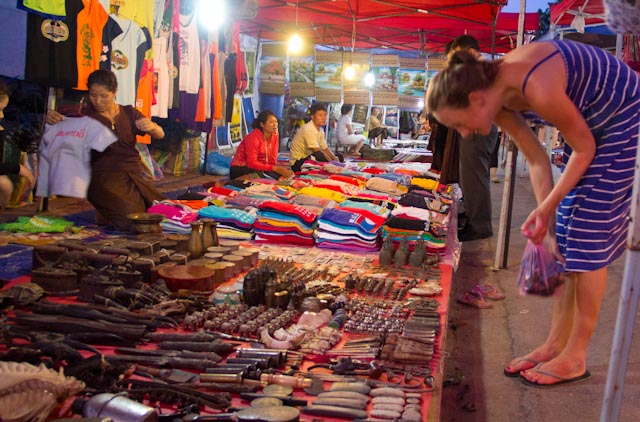
Liz peruses the night market.
Others, like Liz, can spend hours at the morning and night markets when they're not soaking up the beauty of the town and its Parisian cafĂ© culture. And then there's all the Thai-influenced food, cooking classes, sunsets, volunteer opportunities with Big Brother Mouse, and day trips into the mountainous countryside. 

The city is surrounded by two rivers, the Mekong and the Nam Khan. Well-preserved, French-colonial architecture mingles with ornate Buddhist wats, the result of two centuries of Buddhism topped off with five decades of French rule that ended only in 1953.


Beyond the city limits, we spent one afternoon at the incredibly beautiful Kuang Si Falls, just 30 km from Luang Prabang. 
The largest falls, complete with its own "do not swimming" area.
We had a photo with us in it, but it had some obnoxious
tourists in the background. We think this is more serene.
To Kip's enjoyment, the waterfall even had a rope swing, which of course he had to go off of with a back flip. The video can be seen here.


After the waterfall and rope swing visit, we headed back to explore the city. The former capital of Laos until the government was relocated to Vientiane in 1560, Luang Prabang is still known as the religious and spiritual center of the country. At virtually every corner, you can see monks of all ages strolling around town, usually carrying umbrellas to shield themselves from the baking sun and frequent rains. Subsequently, Liz has really taken to this practice. She now goes everywhere with an umbrella and wonders why more people don't do this back home.


Watching the pre-dawn procession of monks receiving their alms is one of the top things for tourists. Each morning monks of all ages walk the streets with empty baskets. As they walk, residents and visitors alike solemnly place food and other items into their baskets. 


It's quite the spectacle, and many visitors seem to forget the ritual is actually a religious procession, not a circus act for photo-happy tourists to set off flash bulbs in the faces of the monks. There are rumors of stopping the processions due to the bad behavior of some tourists.  That said, it is a beautiful thing to witness, if done respectfully, which we tried our best to do. So, since none of our close up face shots of the monks turned out (kidding) above are a couple of images from the processions we were lucky enough to see (when we actually woke up on time to make it).

Bats for breakfast?
And now, for the markets! Luang Prabang has the most incredible markets we've seen in Asia. And trusts us, we've seen a lot of markets. The morning event kicks off around 5 am, and usually ends by 9. 


Lining both sides of a narrow street, vendors lay out their wares on bamboo-woven mats and blankets. Overflowing baskets of rice, piles of noodles, buckets of live eels, grilled frogs, bats, pythons, bug larvae...if it's edible and in the area, it's probably here. We'll let the photos below speak for themselves.  Or, if you feel like getting nauseous (not from the market sales, but from Liz's shaky camerawork) you can view some videos here, and here.
Live, writhing eels straight from the river...come and get it!
Fresh python for sale. 
Lots of veggies, too.
In addition to the morning market, which again, we think was absolutely amazing, there is also a craft and souvenir market in the evenings. While most Asian markets can be chaotic and filled with screaming hawkers giving visitors the hard sell, Luang Prabang's may be the most tranquil and enjoyable on the continent. Needless to say, Liz went a little nuts, particularly with the purchase of elephant trinkets and coin purses.
Liz...still shopping. 

Monday, August 6, 2012

FUNNY MONDAY: DEER MEAT, SOAKED IN...


You can see some strange things on menus and in local markets everywhere around the world. Heck, in Louisiana we even heard there are places you can eat nutria rats and raccoon. At a tiny hole-in-the-wall place in rural Laos though, we found something that tops even those. Seems that, if you like your deer meet with a bit of a bitter taste, you can order it with liquid feces added. For you healthier eaters, you can even have your deer meat over a nice salad..."soaked in liquid feces in the intestine."

Call us cowards, but neither of us tried it. We opted for chicken soup instead. Maybe next time.

Friday, August 3, 2012

PHOTO FRIDAY: GANGSTA MONK?

In some places in Asia, monks and monks-in-training aren't even allowed to ride bicycles. In Vang Vieng, Laos, however, it seems things are a bit different. The young novice above, pedaling across a bridge in early morning, apparently not only can ride a bike, but he can also do so while throwing up gang signs. Considering the kid is studying to some day become a Buddhist monk, it's more likely he was just letting the photographer know he should probably move to the other side of the bridge to avoid a nasty collision. Lest things get ugly. Fast. Wurd. 

Thursday, August 2, 2012

WORLD'S LEAST LIKELY PARTY TOWN

Kids play in a rice paddy just outside Vang Vieng, called "the world's least likely party town."
Vang Vieng is a nature lover’s paradise. Or at least, it used to be. 

Around this small town in central Laos, there are cliffs for climbing, caves for exploring, a river for kayaking, and unpaved roads through rice paddies for biking.
But then, there is Vang Vieng’s top tourist draw--tubing. 

Yes, that's "tubing," as in the state sport of West Virginia. 

Tubers, including Liz and Chris in the front, cross the river to begin their float trip down the Nam Song. 
On the backpacker circuit for several years now, floating down Vang Vieng's Nam Song River on an inflated tractor tire tube has become one of Southeast Asia’s “must do” attractions, at least for 19-year-old gap year students.


Considering the bucolic setting, the more surprising part is that the large majority of participants "do" the Nam Song while drinking and partying as if it were an MTV-hosted spring break in Cancun. One of England’s top newspapers even called Vang Vieng "the world’s least likely party town." 

While we came for the scenery, naturally...we figured we should at least take a closer look at this unique tourism phenomenon, for the sociological if not cultural experience.

People have lots of fun, that's for sure. We certainly did. What you see along the two-hour trip (without stops) can be shocking, both for its natural beauty, as much for the hedonistic scene that awaits you around every bend. 

The Nam Song roars downstream, particularly during rainy season. In dry season, the shallow water hides rocks and other hazards. Meanwhile, the drinks flow as quickly as the current nearby. Everything along the river happens with little to no safety supervision. Not surprisingly, participants are injured constantly. More shockingly, more than 20 international visitors die on the water each year, mostly from head injuries. Little effort has been made to improve safety. 

Despite the dangers, people keep coming, drawn by the party, as much as (or likely more than) the landscapes.
Liz and Chris float past a 200-foot cliff and yet another bar on the way to Vang Vieng.
In addition to bellying up to one of the bars numerous bars along the shore, you can lounge in a hammock for hours, jump on a trampoline, fly down a 50-foot slide, jump from 20-foot towers, as well as soar off of numerous rope swings, which is one of Kip's favorite things (once the water depth and safety of the rope are closely examined, of course...).


In the end, it's hard to beat safely lazing down a rolling river on a steamy afternoon, sipping an icy Beer Lao while sandwiched between rice paddies and 200-foot cliffs. 

And though it's hard to find anyone overtly concerned with safety on the river, we did locate one enterprising bar owner who says he's found a way to help local school children...at his watering hole, there's a sign that reads, "DRINK to help CHILDREN: All profit goes to education!" 

The owner swears all profit from his bar go toward improving education for local kids. We were dubious, but either way, we had a beer and a toast, hoping for all involved that scenery, safety, and education become more of a priority in Vang Vieng.

Kip and Chris supposedly support children's education in Laos.

Tuesday, July 31, 2012

UPRIVER AND LEARNING A LITTLE LAO

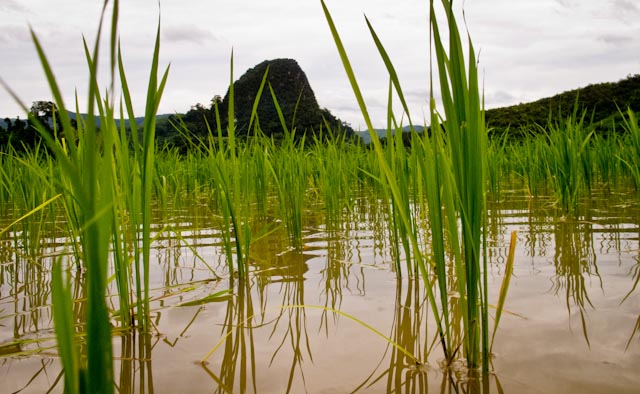
Growing rice, up close and personal.
Heading up Laos' Nam Ou river, a seven-hour boat journey from Luang Prabang is the sleepy town of Nong Khiew. Being that we have grown wise in our travels, we knew that while scenic, a seven hour trip seated on a wooden plank with our knees up near our ears--the only way to travel by water to get to the village--didn't sound all that great. So, we opted for the local bus...only three hours and less than half the price (see how smart/cheap we've become!).

The entire town is located along the river, with a huge bridge spanning the rushing red water. Limestone cliffs tower overhead with lush jungle in between, skirted by an eerie fog that hangs around in the early mornings. We managed to find a hotel room whose main features included a constant leak in the ceiling and a resulting massive puddle in the middle of the floor...but the place also had a balcony and a hammock with amazing views! The balcony was crucial, since it rained the entire time (it is monsoon season, after all) and it was nice to get away from the puddle now and then.

Just an hour farther up the Nam Ou is the even smaller village of Muang Ngoi Nuea (don't ask us how to pronounce this either...Liz got it wrong every time, resulting in us almost getting on a bus bound for the Chinese border). The settlement is accessible only by boat and has electricity for just a few hours each day. Supposedly, the power comes on at 6 and goes off at 10, but in reality, it came on around 7:30 and went off at 9.

While the tiny town itself had little to see, the highlight of Muang Ngoi is a trek along the trails where no motorized vehicles have gone. One morning, Liz headed out for the village of Ban Na, a 45-minute walk into the mountains. On the way she met a very outgoing, 20-year-old rice farmer named "Eh" (not sure how to write that in English, but this must be close).

Eh looking for snakes on the trail through the rice paddies.
Eager to practice his limited English, Eh offered to accompany Liz on her way and showed her a shortcut through the rice paddies, which were incredibly slippery from all the rain. Eh quickly learned how to say “slip and fall," since Liz did exactly that every few minutes along the trails.

Between her graceful falls, Liz learned a phrase in Lao that her new friend Eh thought was very important: “Wait for me!”

He explained that, “If you are in the toilet at the bus station and you hear the motor of your bus start up, you can shout this to the driver and he must wait for you.”

Hard to argue with that logic.

While that exact circumstance hasn't happened (yet), it's been priceless to see the faces of the local transport drivers when we step smilingly into a bus, boat, tuk-tuk, or taxi and say in near-perfect Lao, "Wait for me!"

Now if we could just learn to say, "Where's the bathroom?"

Six muddy water buffalo squeezed into a small pool.
Boats on the Nam Ou river, and the bridge of Nong Khiew.
An albino water buffalo. We thought they were rare, but saw many in Laos.

Monday, July 30, 2012

FUNNY MONDAY: PASSING GRASS?


While traveling around Southeast Asia for the past few months, we've met an exceptionally high number of people who speak English as well or better than we do. That said, English is a complicated language, and the meanings of certain words or phrases often get lost in translation for some non-native speakers. Take the sign above, for example--this beauty was posted on the lawn of the Patuxai, or "victory gate" in Vientiane, the capitol of Laos. We're thinking this was more what they were going for. Although, googling "passing a grass" for alternative meanings gave Liz a good laugh. 

Friday, July 27, 2012

PHOTO FRIDAY: ARE WE THERE YET, MOM? MOM?


It's monsoon season in southeast Asia, which means it rains just about every day here in Laos. Despite the frequent downpours, life goes on, as seen above as a young mother tries to stay dry while taking her two kids to school. It's hard to imagine a scene like this would go over well with authorities back home, but driving one-handed while holding an umbrella (or a baby or lunch or a live farm animal) and transporting multiple small children passes for normal parenting in Laos--and many other countries in the world. 

Friday, July 20, 2012

SPEAKING ENGLISH WITH MONKS IN LAOS

Novice Sing, one of our many English students at Big Brother Mouse in Luang Prabang, Laos.
A novice monk in bright orange robes points to a word in a children’s book and asks Kip, “How do you pronounce this?”

“Motorcycle,” Kip responds slowly, “do you have one?”

“No, we are not allowed to ride the motorcycles or the bicycles either,” he says in hesitant English. As a monk in training, he and other novices are forbidden to ride either modes of transport. “But we watch television at night sometimes. And I have a phone!” He pulls out a bright purple Nokia that clashes as terribly with his robes as one would think it did with his Buddhist lifestyle.

Liz and one of her 'students.'
Meanwhile, Liz was sitting with a group of three 16-year-old boys, two who spoke perfect English, and probably just came to hang out, since school is out until September. The third, another novice monk, was so nervous to speak he shook with every question, but was encouraged by the other two who constantly interjected with swear words and phrases like, “maybe later it will rain cats and dogs.”


We were teaching English to students in Luang Prabang, a UNESCCO World Heritage Center in northern Laos. We teamed up with an organization called Big Brother Mouse, a local non-profit that found a fun, innovative way to help local kids learn to read in their native language, while also teaching them to speak English. They also provide kids a place to hang out for a few hours and stay out of trouble. 


Kip, friend Chris, and Novice Sing.
In Luang Prabang, a historic city whose architecture and cultural heritage attract thousands of tourists from around the world, Big Brother Mouse has turned its “office,” a small two-story wooden structure that used to be someone’s house, into a free language learning center for kids. The group invites English speaking visitors like us to drop by any day of the week to sit down and talk with locals who want to learn the language.

The main goal of the organization is to improve literacy rates throughout Laos. The organization writes, illustrates and publishes children’s books in Lao language then distributes them, via travelers, to remote parts of the country where books and libraries are rarely found. It’s a brilliant and cost-effective (free) concept that seems to be working well for everyone involved. 

We had a great time interacting with the students, who ranged from the aforementioned novice monk to rural school children to young college students who hoped to someday work in the tourism industry. A big thanks to our friend Chris, who showed us up by bringing donations for the kids all the way from Oslo!
Liz and the sign out front at Big Brother Mouse HQ. 


For more information on Big Brother Mouse or to make a donation, visit their website at www.bigbrothermouse.com. From what we’ve seen, they’re doing great work in Laos.

Now we’re on our way to deliver Big Brother Mouse books we purchased to school children in the outlying villages near Phonsovan, famous for a collection of mysteriously-massive jars created some 2,000 years ago, as well as for being home to thousands of unexploded ordinance left over from U.S. bombing during the Vietnam War.

We’ll have more on that later.

Our second day at Big Brother Mouse. No, Liz's hair isn't that blond. Liz is the fourth person on the left.
Liz holding a selection of the children's books we're delivering to children near Phonsovan, Laos.
The sign at Big Brother Mouse HQ in Luang Prabang.