Showing posts with label Kip. Show all posts

Wednesday, January 1, 2014

HAPPY 2014!


First, thanks to everyone who has read the blog -- we hit 100,000 visits earlier this year and we couldn't be more excited. 

We also want to thank all of you who sent us messages, liked us on Facebook, and wrote to us about all the different ways they've been able to make giving back part of their lives...Ben and Ali babysat a newborn howler monkey in Bolivia, Cinde Jeheber who still volunteers at the animal sanctuary in Costa Rica, and Liz's mom, Sheila, who decided to become a weekly volunteer at her local library. Your stories and so many others inspire us to keep our goal of giving back at least one day each week alive. 

Wishing everyone a wonderful 2014. We are excited for all that the new year will bring. 

Wednesday, December 11, 2013

OUR FINAL BOAT TRIP

Yeah, this is not the boat we took. Ours is the sailboat in the top right corner...the Luka.
From the earliest days of this voyage, our luck with boats has been something less than stellar.

Early readers of the blog will remember the original Boat Trip From Hell, as we sailed/drifted for 12 days from Palau to the Philippines with two Germans on their small, not-exactly-modern sailboat. 

Forgetting those painful lessons learned on the Pacific, we tried sailing again months later in Madagascar, this time spending nearly 20 hours crammed into a narrow, dugout ocean-going canoe with a sheet for a sail and the entire Indian Ocean (but no privacy) for a bathroom.

More months and thousands of miles had passed. Surrounded by stunning seas, Panama was the final stop of the trip. The San Blas were some of the most scenic islands we'd ever seen. And we'd soon enough be land-locked back home for who knows how long. 

So yeah, you know where this is going. We decided to sail again. On a boat. Overnight.

But this time, we chose wisely.  


While eating fresh-baked bread and drinking strong Panamanian coffee at the only bakery in Potobello, we overheard three American twenty-somethings talking about a boat trip. From what we could hear, they would be sailing later that day, heading through the San Blas Islands and on to Colombia. 

Naturally, Liz leaned over and said, "Excuse me, did you say you're leaving on a boat trip?" 

Half an hour later, we had already met the Luka's capable, friendly, and honest captain, Bea, who was running around town like a mad woman provisioning the boat in prep for their five-day trip. We told her our plans (a one-night trip in the San Blas was all we had time and budget for), and she said, "Sure, you can have my cabin and we'll drop you off tomorrow somewhere you can catch a motor boat to where you need to go next." 


Like our captain Bea, we spent most of the day running around Portobello buying stuff for our trip. We also squeezed in time visiting the remains of the 400-yr-old fort, watching a soccer game played atop cannons hauled on Spanish galleons, and looking out over the deep bay, the supposed burial place of THE Sir Frances Drake, whose lead-encased body no one's ever found.


We did see an interesting liquor selection at one of the two stores in town that sold booze -- Abuelo rum, Night Train (really?), a fifth of Tanqueray gin for $10, and something called Kentucky Cream whiskey, none of which we tried.


If you do make it to Portobello, a quintessential but gritty sailor town Jimmy Buffet sings about in "Cowboy in the Jungle," you may as well try to meet up with Captian Jack. The pony-tailed, wanna-be pirate is a teller of tales and schemer of schemes who knows just about all there is to know about the surrounding area and far beyond. He also serves quality food, cheap rum and decent rooms if you don't mind bunk beds and a little noise. We loved it.

But the real reason you come here is to catch a boat to places further afield...and so we did. Less than 12 hours after we met our American friends and Captain Bea, we were sailing the Caribbean on a 52-ft ketch, sipping rum, seeing the sea and petting the Luka's official living mascot, Wacek, seen below.

After a peaceful night among a ludicrously starry sky, we shared a filling breakfast with our fellow passengers before disembarking at El Porvenir, a tiny strip of sand and palm trees that hosts a hotel, a recently-paved runway and the San Blas Guna General Congress. 

Here, we took a group photo with our fellow travelers as they departed for Colombian and Kip had to go meet with the big boss (Speaker of the House?) to negotiate our motor boat back to the mainland. 


All in all, it was one heckuva way to spend some of the final days of our trip...and more importantly, to re-affirm our faith in sailing, not to mention in our decision-making abilities when it comes to boats.  

Big thanks to Luka, Captain Bea and the crew! 

Wednesday, December 4, 2013

SAN BLAS ISLANDS II


There's so much to love about the San Blas Islands.

The stunning clarity and colors of the water that laps soothingly over the white sand beaches, which Liz could never seem to get enough of. The ubiquitous bead anklets and bracelets the local Kuna women wear to signify whether they're married or not. The lady below, preparing fresh fish for our dinner is married, as noted by the wide wrap around each ankle. 


The quality of food and accommodation varies from island to island. Since only Kuna people can run businesses in the San Blas Islands (no foreign-owned companies allowed...meaning the Hard Rock San Blas will not be happening there anytime soon), the hotels and accompanying restaurants are run by the same one or two families who inhabit whichever island visitors end up staying on. 

While this often means sleeping arrangements are rustic and meals can be culinarily-challenged at times, the overall experience is one that's becoming more and more difficult to come by.


Above, Liz stands in the doorway of our hut. Amenities include one naked light bulb hanging from the palm roof, one thin mattress resting on cross-cut palm trunks, and a hammock for when the bed filled with sand. After lights out, the darkness is profound, as are the starry skies and the sounds from the waves nearby and the palms overhead. 

For families or groups, there are larger huts with multiple hammocks.


But the main attraction can only be the islands themselves. Picture perfect, whether from a distance...

Or frozen in yoga pose atop one...

Or closing business deals just next to one.

If you have time, the San Blas are so worth a visit (or two). While you're there, take some time to enjoy the scene, learn about the locals, and consider a volunteer activity such as  a beach cleanup.

And of course, don't forget to take dominion over your own palm-crowned private island. It's as unique a place as we've seen on the trip and will definitely be making our Top 10 list, if we ever get around to putting one together. 


Tuesday, December 3, 2013

FUNNY MONDAY: PALM TREE JUMP


From live volcanoes to high bridges to the Taj Mahal, for some reason we like having our photo taken while jumping in the air. Tourists.

So when we saw this reclining palm stretching out over a beach in the San Blas Islands, we went right to it. More or less.

At least the sand was a safer landing than the one Kip would've faced if he missed this jump in Thailand...or if this jumping cat crash landed in a monastery in Burma. 

Monday, October 28, 2013

NAKED TRASH CLEAN UP


No, we didn't get naked to clean up a beach in Panama's stunning San Blas Islands. But a little helper named Christopher, seen here, did.  

We shouldn't have been surprised--the kid rarely wore clothes both times we stayed on his island, a tiny teardrop of sand not much larger than a city block. Of course, considering he lives a Blue Lagoon-like lifestyle surrounded by swaying palms and clear blue waters, who could blame him. 

While the San Blas Islands look and feel close to paradise, the Kuna people who live there are facing critical problems with clean water, sanitation, and trash.


Thanks to the steady stream of tourists and a growing local population, there isn't enough potable water to go around. In addition, all those people are producing lots of waste, which isn't being disposed of properly, leading to polluted oceans, contaminated drinking water, and trash in the water, wrapped around starfish, and dotting the beaches, which we did our best to eradicate with the help of little naked Christopher. 

We even convinced some fellow travelers to join us on the clean up. Together,we walked the beaches, crisscrossed the island, and snorkeled the surrounding waters picking up trash. 

If you do visit the San Blas, make sure to carry out everything you carry in (and more if you have room), and before you book, ask if the island you're on has properly-functioning toilet facilities. If it doesn't, stay elsewhere.


And of course, if you see garbage on the beach, recruit some fellow travelers, and take the time to clean it up. You'll be glad you did, and you might make some new friends in the process.

Monday, October 21, 2013

FUNNY MONDAY: KIP FEEDS LARGE RAT


OK, so the animal is called a coatimundi, and it's not actually alive. But Kip couldn't pass up a photo opp with this larger than life mural on a concrete wall in Panama City's Casco Viejo. 

(No animals were harmed or fed in the taking of this photo.)

Sunday, August 11, 2013

BROTHERLY LOVE AND FAREWELL

Todd and Kip enjoy a romantic sunset on an unnamed beach.
After a fun visit from Kip's brother Todd, it was time for him to head to his new "retired" life in London. 
Kip pretending he's a surfer in Tamarindo.
But not before one last surf session in Tamarindo. 

Farewell, big brother. 

Yes, Todd caught a few waves. 
We had an amazing time and are so glad you came...but...

Most of them briefly.
Here's hoping you retire better than you surf! :)

See you in London!


Wednesday, August 7, 2013

LEARNING SPANISH IN SAN JUAN DEL SUR

Us with Kip's Spanish teacher from waaaay back, Rosa Silva. Yes, she remembered "El Loco."
Most of us remember our favorite teachers, right? 

Kip got a treat when he had the chance to reunite with Rosa Silva, the lovely and very patient lady who helped him learn Spanish some 15 years ago in San Juan del Sur. Since the days of giving leciones de vocabulario on her front porch or in a beachside park, Rosa and her daughter now have their own school and hostel two blocks from the ocean. 

If you're looking for a relaxed atmosphere where you can learn some Spanish and catch a few waves between classes, you could do far worse than the Spanish School House. 

Please tell Rosa that El Loco sent you!

Tuesday, August 6, 2013

VOLUNTEERING IN SAN JUAN DEL SUR

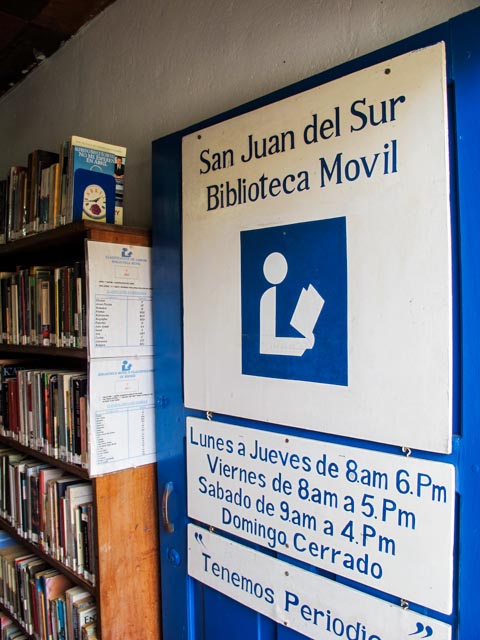
The entrance to the San Juan del Sur Library.
If you've got some time to spare between beach breaks and surf sessions, drop by the San Juan del Sur Library, aka Biblioteca Movil.

Just off the Parque Central about four blocks from the sand, the white-washed, one-story building trimmed out in ocean blue packs a big punch in a tiny package. 

In addition to hundreds of books in English and Spanish for kids and adults, they also offer computer literacy classes, study times, and best of all, a mobile library. 

For those unfamiliar with mobile libraries, first imagine a food truck, but instead of being a place to buy burritos, the library on wheels offers free books for loan in remote communities where libraries exist only in the dreams of the children who live there. 

It's food for the mind.

Travelers-turned volunteers are welcome to tag-along on the Mobile Library's scheduled three-times-per-week trips, which leave SJDS early and come back mid-afternoon. 

Sadly, the trips were on hold for a week-long holiday while we were there. If, like us, you're unable to make a trip with the Biblioteca Movil, the library also accepts new and used books, as well as supplies for their child learning and computer center.  

Drop by the Library for more info, to make a donation and of course, to sign up for a trip on La Biblioteca Movil.

Two librarians fill out library cards and educate visitors about volunteer opporutnities at La Biblioteca Movil. 
In front of the library, Kip waves hello after we dropped off some books and craft materials.

Tuesday, July 30, 2013

VOLCANO BOARDING

Liz flies down the Cerro Negro volcano on a sled made of plywood and hay string. Safety first. 
In the annals of extreme sports, volcano boarding has to rank in the Top 10. 

Thought up by a bored Australian backpacker turned hostel owner in Leon, Nicaragua, the activity involves riding a piece of juiced-up plywood down the steep, black slope of an active volcano at speeds of up to 58 mph (current record).
Liz and Todd wave hello, leading the train up the volcano. Yes, riders have to carry their own boards.
While everyone comes for the trip down, the views on the hike up aren't so bad either.
Breaking the legal speed limit while sliding down lava rocks on a piece of wood? We were definitely giving this a shot. 

Todd and Liz getting instructions from our guide.
The volcano, Cerro Negro, is actually Central America's youngest (born 1850) and its most active, last erupting in 1999. On the one-hour hike up, riders haul their boards past steam spewing from vents along the route. Rocks in various places are hot enough to melt your shoes. 

Despite the heat and the fumes, we hung around, took some photos, goofed off with the 20 or so others on the tour, and finally got around to boarding down the big black mountain. 

After an instructional briefing from our guide, we slipped into our orange prison jumpsuits and donned our protective goggles (both necessary to stop the flying rocks that bombard boarders like doubt all the way down). One by one, we readied ourselves for launch.

No, none of us was able to break the world volcano boarding speed record...although an American guy from our eclectic group (ages 17-43; six continents) did...58.7 miles per hour (they use a speed gun)...on a piece of thin plywood turned turbo using a thin piece of metal and some Formica. 

Insanity. For those wondering, the three of us didn't even get close to that. Maybe next time.
Todd, Liz and Kip with their volcano boards.
The white rectangle is formica, used to reduce resistance. It has to be replaced after every ride.

Liz seconds before her attempt to break the world volcano boarding speed record.
If you'd like to try out volcano boarding, get yourself to Leon, Nicaragua, drop by the Bigfoot Hostel, and say "volcano boarding" to anyone you see. They'll direct you to where to sign up. Tours leave in a huge orange construction truck around 9 most mornings. 
Todd takes his turn down the volcano.
The takeoff is scary enough, but not to worry--the last 100 yards is way worse.

Monday, July 29, 2013

FUNNY MONDAY: VOLCANO JUMP

Some days, you might as well jump. At least, that's what Van Halen said. 


That's what Kip and his brother did, from a rock atop an active volcano during our first stop in Nicaragua. 

Tomorrow, we show how they got down the mountain...an extreme sport called "Volcano Boarding."  Stay tuned...


Monday, June 10, 2013

FUNNY MONDAY: SPHINX KISSING AND CAMEL WRANGLING


Sandy lips?  Too old? Missing a nose? 

Really, who could resist a quick smooch with a 4,500 year old icon? Certainly not Liz. She puckered right up. And no, we're not talking about Keith Richards, although the similarities are striking.

This photographic evidence proves we tried our best to make the most out of every possible photo op during our short time in Egypt. And when it came time to goof off with a camel, Kip was not one to miss out. Unfortunately this camel didn't have the sense of humor of our classic photo-bomber in India.

It's safe to say we had us a good time.

Thursday, June 6, 2013

VOLUNTOURISM WITH SOFT POWER EDUCATION UGANDA

Kids take a break from supervising Liz's painting skills to wave hello. 
Sadly, there are folks out there who still don't comprehend the value of short-term volunteering. 

For example, guidebook publisher Lonely Planet's Africa guide informs potential volunteers that, "Unless you’ve got some expertise, and are prepared to stay for at least a year, you’re unlikely to be much use anyway." 

Really, Lonely Planet? A year or nothing? 

Perhaps the publisher should discuss its ill-advised statement with the folks at Soft Power Education or with the thousands of kids that Soft Power and its short-term volunteers have helped over the years. 

Like Big Brother Mouse in Laos, Soft Power seeks out travelers who aren't able to commit to weeks or months (or a year) of volunteering. The nonprofit offers visitors various options, including a "One Day Volunteering" program, which enables participants to tour its facilities, learn about issues affecting the area, donate, and work on an ongoing project such as painting a school or helping construct a building. 

Kip trying to stay between the lines.
Liz having a much easier time than hubby.
We had a few extra days in Jinja, so we emailed Soft Power through their website to see if they had anything available (click here for tips on finding volunteer opportunities on the road). From there, they hooked us up with an opportunity through their school refurbishment program. 

We were told to meet Kibii, their energetic volunteer manager who grew up nearby, at a local Nile River rafting company. From there, Kibii gave us a tour of some of the projects the organization had completed, including the Amagezi Education Centre and the Kayabirwa Children's Centre. After the tour, off we went in the back of a pickup to the site where we'd spend the rest of the day.
Kip and our guide Kibii, who manages volunteers and organizes projects for Soft Power Education. 
Painting walls back home can get tedious quickly. Yet, there's a certain joy in brushing some color to the walls of a noisy school while being closely-watched by kids who would much rather critique two muzungus working than play outside during recess. The students didn't seem to be going anywhere, so we put them to work and started testing out their English skills. 

"Which letter comes next?" we asked, as we painted our alphabetical-way around the room. In unison, the kids would shout back their answers. "Name an animal that starts with that letter"...and the game continued. 

All was well and good until a teacher came by the room. Playtime was over, it seemed, at least for the kids. 

For us, we still had hours and another alphabet or two to go. And despite the duties at hand, we couldn't wait to keep going.

Interested in volunteering with Soft Power? Check out there volunteer page and see what option works for you. 
Oddly enough, this sign is directly next to this "interesting" building.

Friday, May 31, 2013

PHOTO FRIDAY: HAPPY KIDS, HAPPY ADULTS


Nothing like happy kids to brighten up a day, especially a Photo Friday (which doesn't always have to be glowing sunsets and such).

The crazy kids above, whose classroom we were painting (more on that next week), decided it was time for recess. Then they decided we had to take photos with them and they would put on their happy faces. 

Hard to argue with a room full of grinning nine-yr-olds. 

Tuesday, May 28, 2013

LIZ'S PET RHINO IN UGANDA

Kabira, the Southern White Rhino, happy in her habitat at the Ugandan Wildlife Education Centre.
We will admit, our knowledge of rhinoceroses was limited. Up until this particular day, we had only glimpsed one from afar (as in, really afar, looking like a speck through binoculars) on our recent trip to Serengeti National Park. 

But, we happened to find ourselves with several days in the small Ugandan town of Entebbe, famous for being the staging area for all United Nations vehicles for peacekeeping missions in Central Africa, as well as being the location of a rescue mission of a hijacked Air France plane in 1976.  Perhaps not as well known, the city also happens to have a Wildlife Centre, with a rhino.

Yes, it was time for Liz Dolittle to commune with the animals again, as she's done so often on this trip.

A rhino shows Kip his best side.
In addition to the two Southern White Rhinos, the Ugandan Wildlife Education Centre is also home to giraffes, a baby elephant, lions, chimps, ostriches, and more. But really, as evidenced in the photo at right, we were here for the rhino, which was clearly not having any of Kip's usual antics.

Having no previous rhino knowledge or experience, and just coming off of a close encounter with a semi-aggressive gorilla with a not-so-funny sense of humor, we got a little spooked when this rhino Kip had been harassing walked calmly away, then turned and charged at the fence. Or so we thought.

Clearly we had never heard about Rupert the Rhino, or this family, or Jessica the hippo.

This seemingly dangerous rhino didn't charge the fence. She just ran up to it like an adorable puppy and stuck her horn through for a little scratch. The gorillas were nice, but who knew a rhino in a zoo could be the highlight of our Uganda trip? 
It turns out, this particular rhino, who we have learned is named Kabria, was brought to this wildlife center in 2001 as part of a program to re-introduce rhinos to Uganda, where they became extinct in 1984.  Programs like the one at this centre, and at Ziwa Rhino Sanctuary are leading the charge for re-population, with some recent success, no small feat considering the White Rhino only re-produces once every three to five years.
Kip gives her a good scratch behind the ears, which she loved. 
Unfortunately, Uganda will never be able to recover the population of the extinct Northern White Rhino, and there is still a demand from China and other Asian countries, who believe that the horn is of medicinal value and will purchase the horns for $1400 an ounce, meaning these animals can be worth more dead than alive. 

We can only hope that wildlife sanctuaries like this one can ensure that the population of the Southern White Rhino, like Kabira, can make a comeback.

And maybe, when Liz wins the lottery and comes up with $37,000 she'll be able to buy one of her very own to keep for a pet. 
Rhino toes...almost as big as the camel toe we saw in India.